Loan repayment calculations: equal payments, equal principal and interest-only
Compare a KRW 100 million, 4%, ten-year loan using formulas, first installments, total interest, final principal and the zero-rate boundary.
For KRW 100,000,000 at 4% over ten years, equal principal-plus-interest payments are about KRW 1,012,451 monthly. Equal principal costs more initially but less interest overall; an interest-only loan still owes KRW 100,000,000 principal at maturity.
A small monthly payment does not necessarily mean a small overall cost. Paying principal later leaves interest accruing longer. This guide supplies formulas and examples to compare principal, interest and the final payment without relying on a calculator button.
Which inputs must match first?
Use principal P=KRW 100,000,000, annual rate 4%, monthly rate r=0.04÷12 and n=120 months. Assume an unchanged rate, end-of-month payments and no grace period, arrears, early repayment or fees. This monthly approximation ignores differing month lengths, and displayed amounts round to whole won.
Equal payments keep principal plus interest constant. Equal principal keeps the principal portion constant. Interest-only pays interest during the term and returns principal at maturity. Not every product offers all three options. The Korea Housing Finance Corporation monthly repayment tool provides a further reference for amortization examples.
What are the formulas and totals?
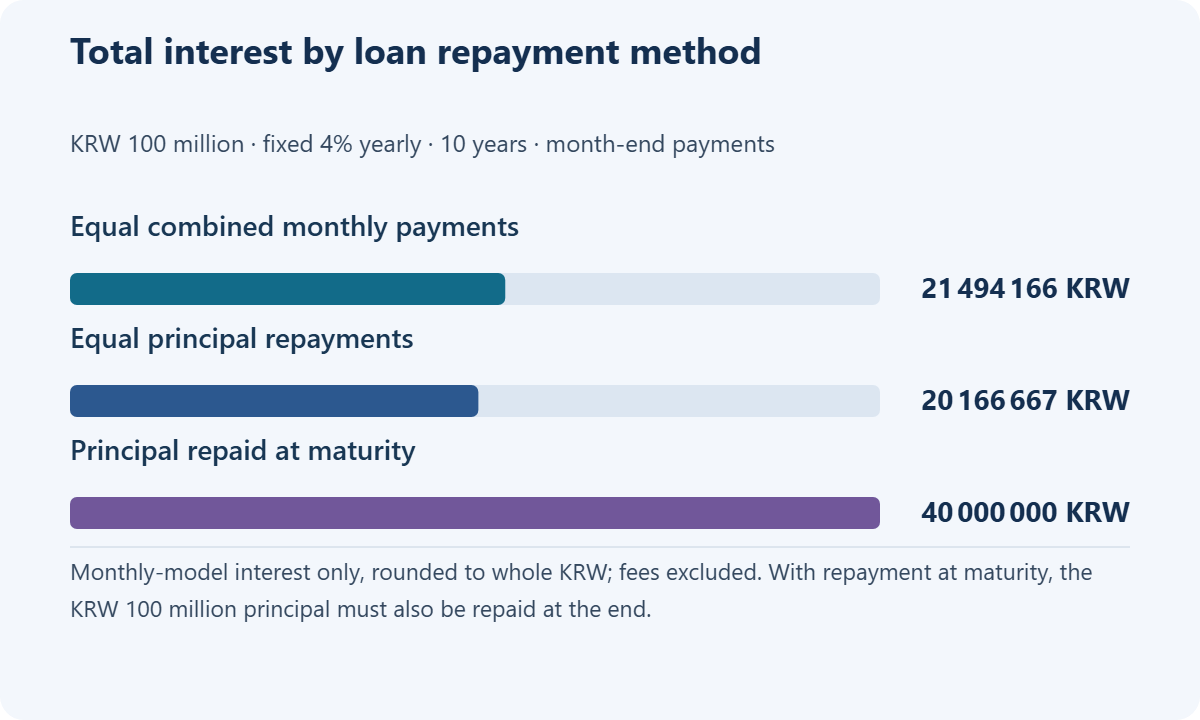
For equal payments, A=P×r÷[1−(1+r)^(-n)]. The unrounded example payment is KRW 1,012,451.3816. Total interest is A×120−100,000,000, approximately KRW 21,494,166. Multiplying the rounded display by 120 introduces rounding differences, so retain unrounded values internally.
Equal principal repays P÷n=833,333.3333 won of principal monthly plus interest on the opening balance. Total interest is P×r×(n+1)÷2=20,166,666.6667 won. Interest-only pays about KRW 333,333 monthly interest, KRW 40,000,000 total interest, and the full principal at maturity.
| Item | Equal payments | Equal principal | Interest-only |
|---|---|---|---|
| First payment | KRW 1,012,451 | KRW 1,166,667 | KRW 333,333 |
| Final payment | About KRW 1,012,451 | About KRW 836,111 | About KRW 100,333,333 |
| Total interest | KRW 21,494,166 | KRW 20,166,667 | KRW 40,000,000 |
| Total including principal | KRW 121,494,166 | KRW 120,166,667 | KRW 140,000,000 |
These are calculations under an identical rate and term. Recalculate if actual product rates differ. The first equal-principal payment is about KRW 154,215 higher than the equal-payment amount, so lower interest still requires sufficient initial household cash flow.
How do you verify the first three payments?
For each month, calculate interest=opening balance×monthly rate, principal repaid=payment−interest, and next balance=opening balance−principal repaid. The first equal-payment interest is KRW 333,333.3333 and principal reduction about KRW 679,118.0483. The next month's interest uses the reduced balance.
| Equal-payment installment | Interest | Principal repaid |
|---|---|---|
| 1 | About KRW 333,333 | About KRW 679,118 |
| 2 | About KRW 331,070 | About KRW 681,382 |
| 3 | About KRW 328,798 | About KRW 683,653 |
Individually rounded cells can sum to one won more or less than a rounded payment. The lender may also adjust the last installment to settle the remaining balance. Following these three steps explains why principal falls slowly early in the schedule.
How does the choice connect to living expenses?
Compare equal payments when predictable monthly spending matters. Compare equal principal when you can afford higher initial payments and value faster debt reduction. With interest-only, specify where the final principal will come from rather than judging the monthly bill alone. Refinancing approval is not assured.
Practical insight: write remaining principal beside the small payment
The hypothetical interest-only payment is about KRW 679,118 below the equal-payment amount. That difference is not free savings: the first equal payment reduces principal by that amount. A household budget containing payments alone conceals maturity risk. Record this month's payment, the balance afterward and the cash needed at maturity together.
For early repayment, compare interest avoided with charges and the reduction in emergency funds. The FSC explanation of early-repayment charges explains why contract dates and actual costs matter. Do not apply a historical average to every agreement. These calculations do not confirm borrowing limits or actual bills.
Frequently asked questions
Q. Which method has the least interest on identical terms?
Equal principal does in this example because the balance falls faster. It requires a higher initial payment, and actual product rates may differ.
Q. Does an equal payment mean equal principal every month?
No. Principal plus interest is constant. As the balance falls, interest decreases and the principal share increases.
Q. Is the final interest-only payment also just interest?
No. Full principal and final interest are due. The example requires approximately KRW 100,333,333 at maturity.
Q. Does the equal-payment formula work at 0%?
Handle zero separately because the displayed formula has a zero-denominator form. Divide principal by months: approximately KRW 833,333, with no interest.
Q. Does a grace period leave the table unchanged?
No. Principal may not decline during the grace period and may then have fewer months to be repaid. Check the highest payment after it ends.
Q. What if the lender's table differs slightly?
Compare origination and payment dates, day counts, rounding and fees against the agreement and lender schedule. Ask for the calculation when differences are substantial.
Related
Match current balances and remaining terms to calculate refinancing interest sav...
FinanceKorean one-home capital gains: exemption checks and taxable gainCheck household, ownership and residence conditions before allocating gains abov...
FinanceEarly severance settlement in Korea: reasons, evidence and calculationsCheck statutory reasons, employer approval, supporting documents and the effect ...
FinanceHow to compare inheritance-tax and gift-tax calculation workflowsUnderstand Korean inheritance and gift tax through a complete gift-tax worked ex...