Early severance settlement in Korea: reasons, evidence and calculations
Check statutory reasons, employer approval, supporting documents and the effect of early severance settlement on later benefits, with a worked gross-pay example.
Early settlement of Korean severance pay is not available simply whenever an employee wants it. Check a statutory reason, the employer's payment decision and supporting evidence in that order.
Check the retirement-benefit arrangement first
In a workplace operating a severance-pay scheme, an employer may settle accrued severance before retirement when the employee requests it for an eligible statutory reason. The law permits payment; meeting a reason does not make payment automatic. Defined-benefit and defined-contribution pension arrangements have different early-settlement or withdrawal rules. Confirm the arrangement with HR and the pension provider.
Official references are Article 3 of the Enforcement Decree of the Employee Retirement Benefit Security Act and the government's Easy Law early-settlement guide.
Which reasons should you examine?
Examples in the current framework include an employee who does not own a home buying a home in their own name and a non-homeowner employee bearing a residential lease deposit. A medical reason has additional conditions: illness or injury requiring at least six months of care for the employee, spouse or qualifying dependent, together with medical expenses borne by the employee exceeding 12.5% of the employee's annual wages.
A bankruptcy declaration or commencement of individual rehabilitation within the five years preceding the application is another category. Wage-peak arrangements, qualifying reductions in agreed working hours, statutory working-time reductions affecting severance and officially specified disaster damage have their own conditions.
A landlord failing to return a deposit is a different fact from funding the deposit for a residence. Do not assume non-return itself establishes a new standalone reason; check whether the actual facts meet the residential-deposit category and its conditions.
Gather evidence before relying on the money
Ask HR whether your arrangement is severance pay, DB or DC. Locate the precise statutory category, then gather evidence for both the reason and its timing: housing-ownership records, purchase or lease contracts, medical expense documents or court decisions as applicable.
Submit the employer's form showing the reason and service period to be settled, and retain proof of receipt. Before payment, obtain an estimate showing gross amount, withholding and the start date used for later severance accrual.
Easy Law gives examples of documents establishing a home purchase and ownership status. The required documents and acceptable timing differ by category. A blog's list cannot replace the official guidance and your employer's requirements.
Reproduce the basic amount
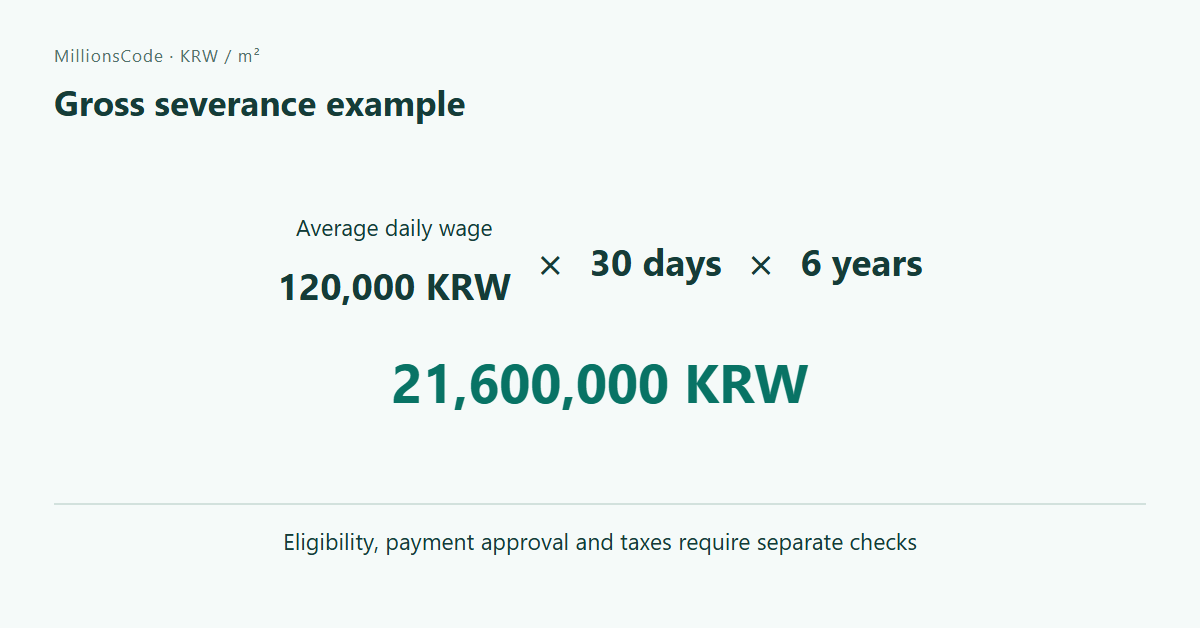
The basic severance concept is at least 30 days of average wage for each year of continuous service. For an illustrative daily average wage of KRW 120,000 and an exactly six-year period, the gross exercise is:
120,000 × 30 × 6 = KRW 21,600,000.
Actual average wage depends on wages during the preceding three months, the calendar days in that period, included bonuses and allowances, and excluded periods. Tax depends on service and retirement-income rules. This multiplication therefore does not replace payroll's calculation.
After early settlement, subsequent severance is generally calculated using service after the settlement point. The employment relationship itself has not ended. Confirm the exact settled period and later calculation basis in writing.
Three gates before applying
Separate the plan type, whether the reason fits Article 3 or is only an unrecovered housing deposit, and whether documents and cash cover the deadline. Mark each verified or unresolved and get the reason, amount and date in writing. Expected support is not income; do not move the deposit or sign before approval.
Practical insight: compare cash now with the later effect
Before committing to another payment, check that the statutory wording matches the facts, the documents and deadlines are confirmed, and the employer has accepted the request. Separate gross entitlement, withholding and the actual deposit into your account.
Compare other funding methods and total costs, not merely the immediate cash received. Find out how settlement changes the later severance calculation. If a housing contract requires a payment before employer approval, consider the risk of being unable to fund it; eligibility should not be treated as cash already available.
Lease renewals, the one-time limit and the wage floor
The deposit reason is not restricted to moving into a different home. A renewal that increases the deposit can also be examined, subject to non-homeownership and the other conditions. The Ministry of Employment and Labor says that extending only the term without an increase, or reducing the deposit, does not qualify on this basis. Compare the old and renewed deposit and the additional payment date using the ministry's renewal guidance.
Settlement on the residential-deposit ground is limited to once while working in the same undertaking. Moving again does not reset it. Ask HR for the date and reason of any earlier settlement. This is a restriction on this particular ground, not a lifetime limit on every statutory ground; see Article 3(1)(2).
Also compare the wage inputs. Under Labor Standards Act Article 2(2), ordinary wage replaces calculated average wage when the latter is lower. Ordinary wage is a legally determined regular-wage measure, not take-home pay arbitrarily divided by days. If verified daily average wage is KRW 110,000, daily ordinary wage is KRW 120,000 and the period is exactly six years, use KRW 120,000 in this comparison. The gross example is KRW 21,600,000 rather than KRW 19,800,000, a KRW 1,800,000 difference. Payroll must verify the wage components and actual service days.
These three points were checked on 2026-09-28. A deposit increase still requires the employer's payment decision and document review.
Frequently asked questions
Q. Must the employer pay whenever a statutory reason is met?
The law allows payment. Employer rules and evidence review still matter, so do not treat it as automatic.
Q. Is an unreturned rental deposit a new independent reason?
A standalone category of that description was not identified in Article 3 at review. Distinguish it from an eligible employee who does not own a home funding a residential deposit.
Q. Does any medical bill qualify?
No. The conditions include at least six months of required care and expenses exceeding 12.5% of annual wages, along with the other statutory requirements.
Q. Does an old bankruptcy or rehabilitation decision qualify?
Check whether it falls within the five years preceding the application.
Q. Does early settlement erase employment service itself?
No. Employment continues, but the service period used to calculate subsequent severance starts anew after the settled period.
Q. Can this example confirm my tax and take-home payment?
No. Wage records, scheme type, service and tax circumstances require individual confirmation with payroll, the pension provider and appropriate tax guidance.
Reviewed September 8, 2026. Law and employer arrangements can change. Recheck the official provision when applying.
Related
Compare a KRW 100 million, 4%, ten-year loan using formulas, first installments,...
FinanceCalculating mortgage refinancing: outstanding principal, matching terms and cost recoveryMatch current balances and remaining terms to calculate refinancing interest sav...
FinanceKorean one-home capital gains: exemption checks and taxable gainCheck household, ownership and residence conditions before allocating gains abov...
FinanceHow to compare inheritance-tax and gift-tax calculation workflowsUnderstand Korean inheritance and gift tax through a complete gift-tax worked ex...