Comparer dépôt unique et épargne par versements : dates et intérêts nets
Calculez 260 000 wons sud-coréens d’intérêts et 219 960 nets avec 12 versements de 1 million de wons sud-coréens, un au début de chaque mois, à 4% simple annuel. Comparez aussi flux du dépôt unique et coûts des bonifications.
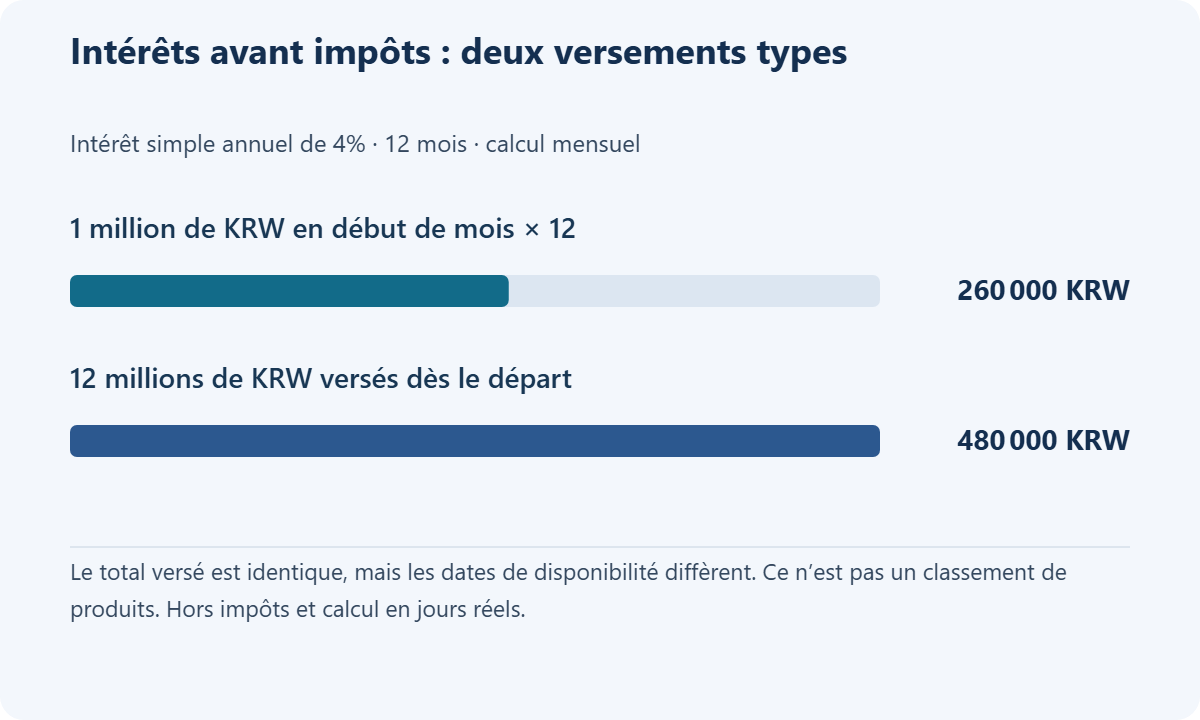
À taux annuel identique, l’argent n’entre pas aux mêmes dates. Avec 12 versements de 1 million de wons sud-coréens en début de mois à 4% simple annuel, l’exemple mensuel donne 260 000 wons bruts et 219 960 nets sous hypothèse d’imposition ordinaire.
Placer 12 millions immédiatement diffère d’épargner 1 million nouvellement disponible chaque mois. Séparez argent présent et futur avant comparaison. Les 4% sont une hypothèse, pas un taux commercial actuel.
Pourquoi les intérêts diffèrent-ils ?
Le dépôt unique rémunère tout le capital dès le début. Chaque versement échelonné commence à produire à sa date. Avec 12 versements, un au début de chaque mois, et échéance à la fin du douzième mois, le premier rapporte pendant 12 mois, le dernier 1. Attribuer une année entière à chacun est faux.
Les banques peuvent compter jours réels, retards, années bissextiles et clauses. Ici un mois vaut un douzième d’année pour comparer la structure. Si les wons entiers du reçu diffèrent, vérifiez décompte des jours et troncature fiscale.
Que rapporte 1 million par mois pendant 12 mois ?
Avec versement M, taux annuel r et nombre n, l’intérêt brut simple en début de mois est M×r÷12×n×(n+1)÷2. Omettre n ou mélanger unités annuelles et mensuelles modifie le résultat.
Ici 12+11+…+1=78 mois de versements, donc 1 000 000×0,04÷12×78=260 000 wons sud-coréens. Capital versé : 12 000 000. Pour un résident ordinaire de Corée du Sud percevant des intérêts imposables, on suppose 15,4% de retenue, soit 14% national et 1,4% local. Impôt : 40 040 ; intérêt net : 219 960 ; échéance : 12 219 960 wons sud-coréens. Consultez les taux de retenue du fisc coréen et la fiscalité du produit.
| Hypothèses mensuelles simples | Versements en début de mois | Dépôt unique initial |
|---|---|---|
| Versement | 1 million de wons sud-coréens par mois, 12 fois | 12 millions de wons sud-coréens le premier jour |
| Taux annuel et durée | 4% · 12 mois | 4% · 12 mois |
| Intérêt brut | 260 000 wons sud-coréens | 480 000 wons sud-coréens |
| Impôt supposé 15,4% | 40 040 wons sud-coréens | 73 920 wons sud-coréens |
| Intérêt net | 219 960 wons sud-coréens | 406 080 wons sud-coréens |
| Montant à échéance | 12 219 960 wons sud-coréens | 12 406 080 wons sud-coréens |
Le dépôt unique rapporte plus car le même argent reste plus longtemps. Ne supposez pas déjà acquis 12 millions non encore gagnés pour conclure qu’il est toujours meilleur.
Même capital initial : ajoutez l’intérêt de l’argent en attente
Supposons les 12 millions disponibles dès le départ. À 4% pendant 1 an, ils donnent 480 000 wons bruts. En transférant 1 million chaque début de mois vers une épargne à 4%, comptez aussi le placement du reste.
| Usage des mêmes 12 millions de wons sud-coréens | Intérêt brut | Net supposant 15,4% |
|---|---|---|
| Tout au premier jour à 4%, 12 mois | 480 000 wons sud-coréens | 406 080 wons sud-coréens |
| 1 million en début de mois à 4% + attente à 2% simple | 370 000 wons sud-coréens | 313 020 wons sud-coréens |
Dans la seconde méthode : 1 million de wons sud-coréens × 0,04 ÷ 12 × (12+11+…+1) = 260 000 wons sud-coréens. Après le premier versement, 11 millions attendent, puis diminuent de 1 million mensuel. La somme des soldes mensuels, 66 millions, multipliée par 0,02 ÷ 12, donne 110 000 d’attente, soit 370 000 au total.
Produits réels, jours, dates, versement mensuel d’intérêts, variations de taux et troncature fiscale peuvent différer. Ici intérêts mensuels simples et 15,4% identiques, sans réinvestir les intérêts d’attente. Pour un épargnant alimenté par salaire mensuel, 12 millions au premier jour ne sont peut-être pas une option possible.
Le guide fiscal sur la retenue d’intérêts indique 14% national pour les intérêts ordinaires. Les 15,4% incluent le local à titre d’exemple, sans représenter exonération ou impôt final personnel. Vérifiez les deux placements séparément avec le calculateur d’intérêts, et l’attente à part.
Trace de vérification : le 15 septembre 2026, 12 versements et soldes d’attente mensuels ont été calculés directement et rapprochés du capital total et de chaque intérêt. Notez aussi séparément les dépenses supplémentaires nécessaires aux bonifications.
Conditions et limites avant souscription
Repérez taux de base et maximum, durée de bonification, plafond mensuel, retrait partiel et taux de résiliation anticipée dans des documents du même jour. Vérifiez la protection produit par produit. La Commission sud-coréenne indique qu’à compter du 1 septembre 2025, le plafond est passé à 100 millions de wons sud-coréens par personne et établissement, capital et intérêts prescrits compris. Tous les produits ne sont pas protégés. Voir protection des dépôts.
Exonérations, imposition globale des revenus financiers, non-résidents et produits spéciaux peuvent différer des 15,4%. Les nets ne fixent pas l’impôt final individuel. Bloquer de l’argent bientôt nécessaire puis résilier peut supprimer le taux initialement comparé.
Questions fréquentes
Q. Une épargne à 4% donne-t-elle 4% de tous les versements ?
Pas s’ils sont mensuels. Chaque somme compte pour sa durée ; les 12 débuts de mois donnent ici 260 000 wons sud-coréens bruts.
Q. Est-ce pareil en fin de mois ?
Non. La durée rémunérée change. Distinguez hypothèse du calculateur et dates réelles de transfert et échéance.
Q. La formule couvre-t-elle les intérêts composés ?
Elle est simple. Le composé exige un autre calcul avec fréquence de capitalisation et dates des versements.
Q. Pourquoi ne comparer que les maxima serait-il insuffisant ?
Une bonification inaccessible n’est pas votre taux. Comparez base, avantage réalisable et coût des conditions.
Q. Déposer 100 millions est-il entièrement protégé avec un plafond de 100 millions ?
Le plafond comprend les intérêts prescrits et cumule les autres dépôts protégés du même établissement. Prévoyez une marge pour les intérêts.
Q. Pourquoi l’échéance bancaire diffère-t-elle légèrement ?
Vérifiez calcul quotidien, retards, traitement fiscal des wons et clauses. Cet exemple mensuel ne remplace pas le contrat.
Tableau comparatif avant la souscription
Renseignez une ligne par produit : produit | taux de base et bonus atteignable | dates réelles de versement et d’échéance | intérêt brut, hypothèse fiscale et intérêt net | taux de sortie anticipée et coût des conditions | éligibilité à la protection des dépôts. 15,4 % est une donnée d’exemple, pas votre impôt final. Ne comparez au même capital le dépôt, l’épargne mensuelle et les liquidités en attente que si le capital est déjà disponible. Les conditions du produit et son calcul priment en cas d’écart de dates, de jours ou d’arrondi.
Connexe
Garder votre contrat silson actuel ou passer à la 5e génération ne se décide pas...
Coût de la vie et financesChanger de forfait mobile : comparer le coût réel sur 12 moisComparez maintien, changement immédiat et attente en intégrant restitution des r...
Coût de la vie et financesEuros en voyage : comparer coût total, distributeurs et DCCComparez le total en wons pour les mêmes 500 euros. Les exemples distinguent mar...
Coût de la vie et financesAchats à l'étranger vers la Corée : seuils de USD 150 et USD 200 et taxesDistinguez seuil d'exonération et valeur en douane. Un exemple complet calcule d...