How to choose air purifier capacity using room area and specifications
Choose an air purifier using measurable criteria: room area, certified coverage, CADR, noise, power consumption, replacement filters and safety information.

Compare air purifiers in one table using the room's area, certified coverage, CADR, noise, power consumption, filter availability and safety information, rather than brand rankings.
Calculate the room area first
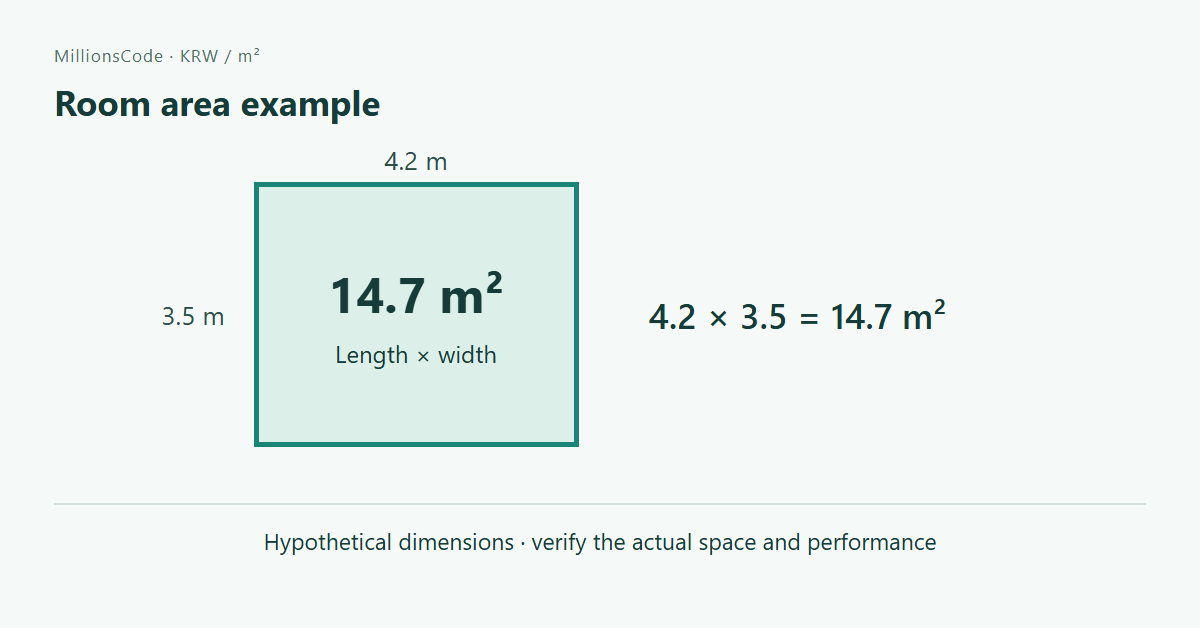
Measure the room's internal length and width with a tape measure and calculate area (㎡) = length (m) × width (m). A room 4.2m long and 3.5m wide measures 4.2 × 3.5 = 14.7㎡. If the living room and kitchen are open to each other, measure the whole connected air space. Treat rooms used separately with their doors closed as separate spaces.
The coverage shown on a product is a value obtained under test conditions. Ceiling height, open doors, cooking smoke, pets, clogged filters and placement can change real-world results. Check the coverage and test standard on the certificate or specifications rather than an advertised size category in Korean pyeong.
Compare CADR and certified coverage in consistent units
CADR measures how much clean air a purifier supplies over a given time. Check whether the unit is m³/h or CFM; do not directly compare different units. The US Environmental Protection Agency's air cleaner selection guide explains checking CADR against room size. For products sold in South Korea, request the certificate and coverage for the exact model number from the manufacturer, rather than relying on the sales name. Coverage measured under different standards cannot simply be treated as equivalent performance.
For example, if two candidates cover 20㎡ and 30㎡ and the room is 14.7㎡, both figures exceed the room area. Next compare noise at the same airflow, installation space, power consumption and filter costs. A larger unit is not always quieter or more efficient: look at figures for the operating settings you will actually use.
Compare noise and electricity use numerically
For a bedroom, the sleep-mode dB rating matters as much as noise at maximum airflow. Decibels are logarithmic, so numerical differences do not translate into a simple proportional change in perceived noise. Background noise varies in shops, so check specifications and return conditions as well as listening.
For an electricity-use exercise, calculate power (kW) × daily operating hours × 30 days. At an average 25W for 12 hours daily, this is 0.025 × 12 × 30 = 9kWh. Actual power varies with airflow and sensor operation. Electricity charges depend on the household's progressive tariff band in South Korea.
Match the unit number with the filter number on one line
Two models were compared using Xiaomi's official specifications on September 15, 2026. Having 4 in the product family name does not mean they use the same filter. This is neither a sales ranking nor a test of actual cleaning performance.
| Item checked | Smart Air Purifier 4 Lite | Smart Air Purifier 4 |
|---|---|---|
| Unit model | AC-M17-SC | AC-M16-SC |
| Filter model | M17-FLP-GL | M16R-FLP-GL |
| Filter diameter × height | 200 × 310mm | 210 × 293mm |
| Manufacturer's CADR | 360㎥/h | 400㎥/h |
| Manufacturer's coverage | 25~43㎡ | 28~48㎡ |
| Current genuine-filter price and stock | Unverified | Unverified |
Sources: 4 Lite unit, 4 unit, Lite filter and 4 filter. An official page does not establish that stock can be ordered today. Maximum CADR must not be presented as measured sleep-mode performance.
Do not count the initial filter twice in a 36-month cost comparison
Assume the unit includes its first filter and is used until just before the end of 36 months. Replacement every 6 months requires 5 extra filters, at months 6·12·18·24·30. Replacement every 12 months requires 2, at months 12·24. A new filter for continued use beyond month 36 is assigned to the next period. Replacement intervals depend on the operating environment.
Enter unit purchase price + extra filter count × genuine-filter price including shipping + electricity costs for 36 months in the table. Leave electricity costs unverified if average power and the actual tariff are unknown. Do not treat the unit's maximum rated power as a measurement of all-day use. Before ordering, match both the unit and filter model numbers, not just similar names.
Check ozone, sterilization features and recalls
The EPA's indoor air filtration guidance also advises checking ozone emissions and maintenance costs. For ion, plasma or sterilization features, inspect emissions testing, whether the feature can be disabled and the manual, rather than trusting the feature name.
An air purifier does not replace ventilation. Ordinary particle filters should not be assumed to remove carbon dioxide, carbon monoxide or every gas. Reduce pollution at its source and ventilate when cooking. Keep the unit the distance from walls and curtains specified in the manual.
Order for eliminating candidates
Exclude a model if its coverage is smaller than the connected room or its test standard cannot be checked. Match the main-unit and filter numbers in official specifications, then record sleep-mode noise, daily hours and your electricity limit. Check filter price and supply and calculate 36-month cost; put it on hold if the filter is discontinued or delivery is unclear. Finally check evidence and shut-off options for ozone, ion and sterilization features. If area, filter, noise, cost or safety is unknown, do not rank; ask with the exact model number.
Practical insight: verification and selection checklist
- Calculated the actual connected room area in m²
- Checked certified coverage, CADR units and test standards
- Compared noise at sleep, medium and maximum settings
- Calculated monthly kWh from power consumption
- Checked the exact replacement-filter model, price and availability
- Checked safety notices, recalls, emissions and whether features can be disabled
- Made a separate ventilation and pollution-source removal plan
Limitations and frequently asked questions
Q. Is coverage equal to the room area sufficient?
Test conditions differ from actual surroundings. Balance capacity headroom against noise after considering open doors, ceiling height and pollution sources.
Q. Is the highest-CADR product the best?
No. Consider noise, power, size, filter supply and safety conditions together.
Q. Does an air purifier replace ventilation?
No. Carbon dioxide and gases from pollution sources require ventilation and source control.
Q. Does this article recommend a particular model?
No. It provides a measurable selection process without ranking models.
Q. Is maximum CADR available in sleep mode too?
Do not read performance measured at maximum airflow as sleep-mode performance. Check both airflow and noise data for the setting you will use.
Q. How many years of filter costs should I compare?
Apply the same expected service period to both candidates. Include actual replacement counts and filter shipping costs, not just the unit price.
Existing space and safety guidance checked: 2026-09-08. Manufacturer specifications for the two models compared: 2026-09-15. Specifications and safety notices may change, so recheck official certification, manufacturer and government information on the purchase date.