How to compare car-insurance quotes with identical inputs
Compare Korean car-insurance quotations with identical coverage and driver inputs, including deductible minimums, maximums and conditional discounts.
Compare car insurance only after matching the vehicle, drivers, limits, deductible and discount assumptions. A lower annual premium does not by itself mean equivalent protection for less money.
Fix the inputs before requesting quotes
Write down the registration or vehicle model, model year and use, policy start date, named insured, permitted drivers, youngest driver's age and expected annual mileage. Match bodily-injury and property-damage liability, personal-injury cover, own-vehicle damage, uninsured-motorist cover and roadside assistance.
Start with the Korea Non-Life Insurance Association motor-insurance portal. Its motor-liability law information provides the legal context for compulsory insurance. Individual premiums depend on insurer assessment, the vehicle and driver history. An age-group average is not your quote.
Record differences, not just the final premium
Assume quote A is KRW 780,000 and quote B is KRW 720,000 annually. The difference is KRW 60,000. If B has a lower property-damage limit or a different own-damage deductible, this is not a like-for-like comparison. Correct the inputs before treating the difference as a saving.
Annual premium divided by 12 gives a budgeting equivalent, not necessarily a monthly-payment option. Card-instalment charges and permitted payment schedules are separate. If renewal costs rise, examine rating class, traffic violations, vehicle value, driver scope, special clauses and insurer pricing—not just whether one accident occurred.
Read the deductible as a range
Check third-party limits against the loss being insured. Personal-injury cover options can have different payment methods and limits; similar names do not mean equivalent benefits. For own-vehicle damage, inspect covered events, insured vehicle value, exclusions and deductible minimums and maximums.
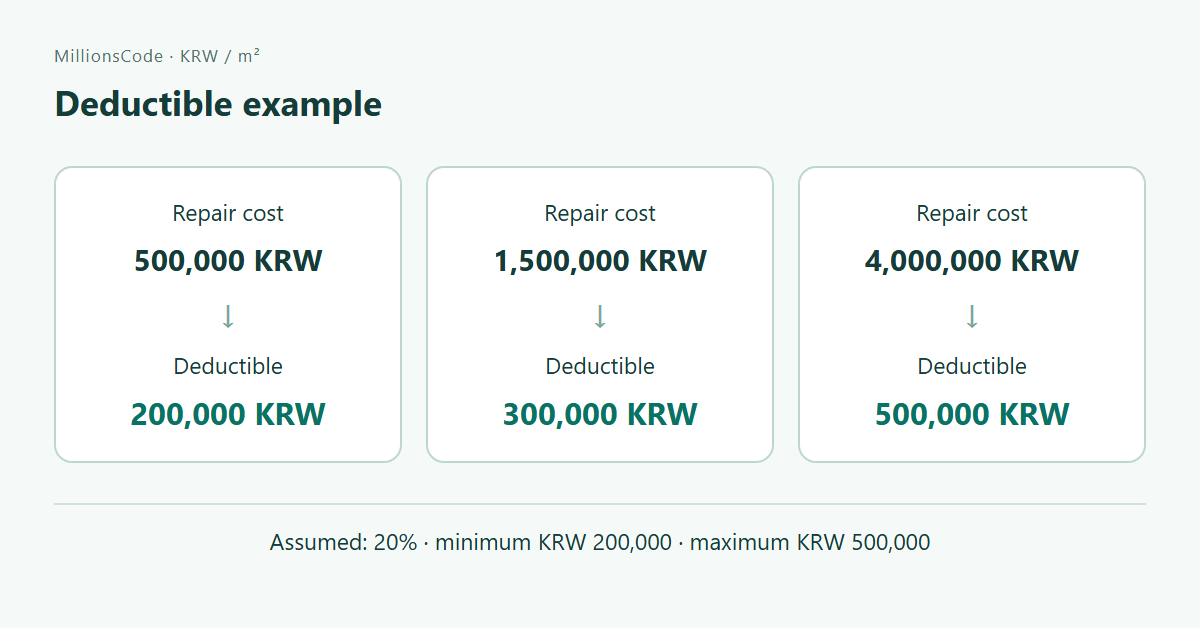
Suppose the deductible is 20% of covered repair costs, with a minimum of KRW 200,000 and maximum of KRW 500,000. At KRW 1,500,000, the illustrative deductible is KRW 300,000. At KRW 500,000, the 20% calculation gives KRW 100,000, but the minimum raises it to KRW 200,000. At KRW 4,000,000, the percentage gives KRW 800,000, but the maximum limits it to KRW 500,000.
The exercise is min(500,000, max(200,000, repair cost × 20%)). Actual claim treatment still depends on the accident, liability, policy wording and loss assessment. This is not a payment promise.
Count only discounts you can substantiate
Mileage, dashcam, child, safe-driving and advanced-safety discounts may have similar names but different evidence, timing and settlement rules. Use realistic mileage and check what happens if it is exceeded. Separate an up-front reduction from a possible refund after the policy expires.
Ask the present insurer for accurate accident dates, paid amounts, fault information and claim status. If considering reimbursing an insurer for a small claim, compare the reimbursement with the insurer's assessment of later premium effects. Reimbursement is not automatically economical.
Lock two quotations to the same conditions
Record vehicle, use and period; driver range and age; coverage limits; own-damage deductible; evidence-backed discounts, claims and mileage; and annual premium plus installment cost for both A and B. If any input or limit differs, write “hold: conditions differ,” not “A is cheaper.” Recheck the final application and policy before payment.
Practical insight: save the comparable version
Keep the date and reference for each quote along with the vehicle use and start date, named insured, driver and age limits, liability limits, personal-injury option, own-damage percentage and minimum/maximum, provable discounts, current mileage and history, exclusions and roadside-service limits.
A small price difference should trigger a conditions check, not immediate purchase. Saving a screenshot of the agreed inputs helps identify whether a later final offer changed the coverage or merely updated the price.
Frequently asked questions
Q. Do drivers of the same age pay similar premiums?
Not necessarily. Vehicle, insurance history, accidents, violations, permitted drivers and clauses also matter.
Q. Should I select the cheapest quote?
Only compare price after matching inputs and protection. Lower limits or a larger deductible may explain the lower cost.
Q. Does family-only cover allow every relative to drive?
Check the policy's definition of family and age restrictions. Do not infer eligibility from the label.
Q. Is an online estimate the final premium?
Disclosure, underwriting and evidence can change it. Check the final application before payment.
Q. Is annual premium divided by 12 my actual monthly bill?
No. It is a budget equivalent. Check instalment fees, available schedules and payment conditions separately.
Q. Is an expected mileage refund guaranteed?
No. Actual mileage, evidence and policy conditions control it. Record the initial premium and potential later refund separately.
Reviewed September 8, 2026. Insurance outcomes depend on personal facts and current policy wording. This guide does not guarantee acceptance, a premium or claim payment.
Related
Compare staying, switching now and waiting over 12 months of Korean mobile bills...
Living costs and financeComparing lump-sum and installment deposit interest: payment timing and after-tax returnsCalculate 260,000 South Korean won in interest and 219,960 after tax for 12 star...
Living costs and financeEuro travel exchange: compare EUR 500 and ATM feesCompare total won costs for EUR 500, distinguish proportional and fixed fees, an...
Living costs and financeKorean overseas-shopping thresholds: USD 150, USD 200 and tax calculationDistinguish Korea's list-clearance thresholds from taxable customs value and cal...