Will switching to a Korean budget mobile plan save money? Compare 12 months of costs
Compare staying, switching now and waiting over 12 months of Korean mobile bills, including promotional prices, repayment charges, lost bundle discounts and device instalments.
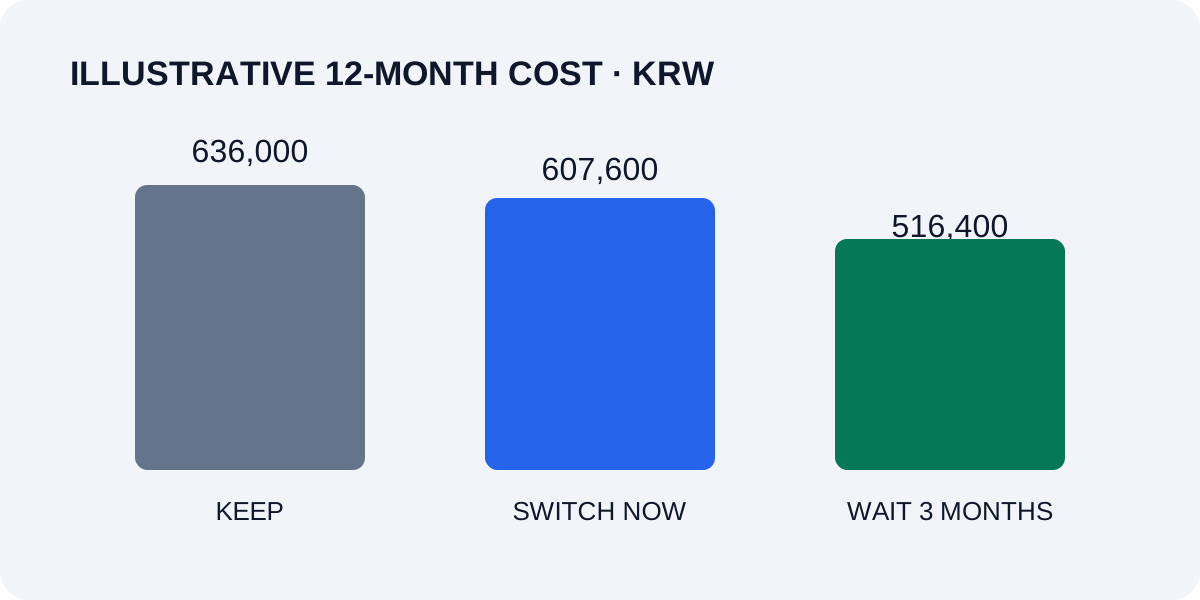
A monthly price of KRW 6,900 makes switching look tempting. But the bill after the promotion, family internet discounts and remaining device instalments can change the result. This guide compares staying, switching now or waiting until the commitment ends over the next 12 months, while keeping the same phone. It concerns Korean mobile products and charges.
First check whether the services are comparable
Use your last three bills to record actual data, ordinary and supplementary-call minutes, and tethering use. Tethering shares your phone's internet connection with a laptop or another device. Plans that slow down after an allowance is used are not equivalent just because their headline data allowances match. Exclude plans that cannot cover your needs before comparing prices.
We checked the following official pages on September 28, 2026. The advertised monthly prices matched, but the conditions differed. This is an example of fields to compare, not a lowest-price ranking.
| Item | U+ U Mobile LTE (7GB+/basic calls) | Same-named [더알뜰플랜2] plan |
|---|---|---|
| Displayed monthly price when checked, including VAT | KRW 15,900 | KRW 15,900 |
| Displayed data | Basic 7GB + extra 10GB, then 1Mbps | 7GB, then 1Mbps |
| Ordinary voice and messages | Included as specified by the plan | Included as specified by the plan |
| Supplementary calls | 300 minutes | 110 minutes |
| Conditions to check separately | Extra data benefit lasts 24 months | 24-month commitment; discount repayment conditions for early change or cancellation |
The first plan's extra-data expiry is not necessarily its monthly-price discount expiry. The second says it converts to a regular product when the commitment ends. A crossed-out price does not establish the future bill. Check the discount period for your application type, price after conversion and SIM costs on the application screen or with support. Keep convenience-store coupons and Npay benefits separate from bill discounts. Their savings on living expenses may be zero if you cannot meet their conditions. Regular product, 더알뜰플랜2 product.
Seven figures to obtain from bills and support
- Current mobile service charge after actual discounts, including any contract discount, but excluding device instalments.
- The new promotional price, number of months it applies and price afterward, recorded separately.
- Separate repayment-charge quotes for switching today and after waiting. Do not infer these just from months remaining.
- The increase in other family or internet bills when this line leaves. Do not add a discount already reflected in the current mobile charge again.
- Remaining device payments and their schedule, including instalment fees.
- One-off SIM/eSIM, delivery and activation charges, and conditions for waivers.
- Excess-data charges and other additional amounts for the planned switch date.
Porting a number does not erase device instalments. SK Telecom's official application form distinguishes paying off the old provider's instalments from continuing to pay them. Ask your existing provider for the balance and payment arrangement. SK Telecom mobile contract form, page 1.
The formula is 12-month service charges + increases in other family/internet bills + repayment charges + one-off costs + device payments + extra usage charges. Add only the internet-bill increase caused by the switch, not the family's entire internet bill.
Hypothetical example: what does KRW 6,900 really save?
These are assumptions for a reproducible calculation, not quotes for the two official products above. Compare 12 complete billing months starting today. Keep the existing device; assume all three options cover the required calls and data, with no extra usage charges.
| Input | Assumption |
|---|---|
| Current service charge | KRW 33,000/month |
| New service charge | KRW 6,900 for the first 6 months of use, then KRW 25,900 |
| Existing device payments | KRW 20,000/month for the next 12 months |
| Increase in other family/internet bills after switching | KRW 5,500/month |
| Repayment charge on existing contract | KRW 96,000 now; zero after waiting 3 months |
| One-off SIM and similar costs when switching | KRW 8,800 |
Assume the new plan continues through the comparison period and is not cancelled at its end. If you intend to cancel after 12 months, add any repayment charge on the new contract then. Coupons and gifts are excluded.
| Cost over 12 months | Stay | Switch now | Switch after 3 months |
|---|---|---|---|
| Service charges | KRW 396,000 | KRW 196,800 | KRW 218,100 |
| Increase in other bills | KRW 0 | KRW 66,000 | KRW 49,500 |
| Repayment + one-off costs | KRW 0 | KRW 104,800 | KRW 8,800 |
| Existing device payments | KRW 240,000 | KRW 240,000 | KRW 240,000 |
| Total | KRW 636,000 | KRW 607,600 | KRW 516,400 |
| Saving against staying | — | KRW 28,400 | KRW 119,600 |
Switching now gives service charges of 6,900 × 6 + 25,900 × 6 = KRW 196,800. Waiting combines 3 months at the current price and 9 on the new plan: 33,000 × 3 + 6,900 × 6 + 25,900 × 3 = KRW 218,100. All options use the same 12 months starting today; do not count 15 months for the waiting option alone.
Waiting three months costs least under these assumptions. But that assumes the same introductory offer remains available then. Obtain the actual sales terms and repayment quote again at that time. Waiting does not always reduce a repayment charge to zero.
Checking the calculation: common questions
Q. Can lost bundle discounts reverse the result?
Change only the increase in other family/internet bills from KRW 5,500 to KRW 8,800/month. Everything else stays the same. Switching now totals KRW 647,200 over 12 months, KRW 11,200 more than staying. A much lower mobile base price can still increase household spending.
The bundle-discount loss that makes immediate switching equal to staying is approximately KRW 7,867/month here: (396,000 - 196,800 - 104,800) ÷ 12. This is not a universal threshold. Your repayment charge and new prices change the boundary.
Q. Does a cheaper year also mean a smaller first bill?
Check the first month separately. Immediate switching in the base example costs KRW 137,200 in month one, including the device payment. Subsequent savings recover the initial costs in month 6. At month 5, cumulative spending is still KRW 1,800 above staying; at month 6, cumulative savings reach KRW 18,800.
If all KRW 240,000 of remaining device payments are paid in month one, the annual total stays the same assuming no fee savings, but that month's outlay becomes KRW 357,200. If early payoff changes fees, use the actual payoff quote instead.
Q. If I switch mid-month, do I simply pay for the days used?
Both base charges and data allowances may be prorated. The U+ U Mobile product guidance includes an example in which a reduced allowance leads to excess charges. A few days of use are not automatically cheap. Distinguish a plan change within the same provider from porting to another provider. Billing and plan-change conditions.
Calculate from your own bills
Open the worksheet CSV, with Korean field labels in Excel or Google Sheets and enter 12 rows each for staying, switching now and waiting. Blank fields are not automatically zero; enter 0 only where you have confirmed there is no cost. Apply the new price when the promotion ends. Enter repayment and SIM costs once, in the month they occur.
We checked the example with code that sums monthly costs and a separate aggregate calculation. The hypothetical monthly calculation table shows every month. This was not an actual subscription or billing test; it assumes 12 complete billing months. For a real mid-month switch, include prorated fees and extra charges.
Ask support: “If I move on this date, what are the repayment charge and final usage charge separately?”, “How much will each other family and internet bill rise without this line?”, and “What are the post-discount monthly price and the repayment conditions on the new commitment?” Then choose a date after comparing both the total and first-month burden for all three options.
Related
Calculate 260,000 South Korean won in interest and 219,960 after tax for 12 star...
Living costs and financeEuro travel exchange: compare EUR 500 and ATM feesCompare total won costs for EUR 500, distinguish proportional and fixed fees, an...
Living costs and financeKorean overseas-shopping thresholds: USD 150, USD 200 and tax calculationDistinguish Korea's list-clearance thresholds from taxable customs value and cal...
Living costs and financeA solo-living budget: monthly bills, delivery meals and move-in costsBuild a solo-living budget with worked examples for weekly meal costs, moving-co...