Comparing lump-sum and installment deposit interest: payment timing and after-tax returns
Calculate 260,000 South Korean won in interest and 219,960 after tax for 12 start-of-month payments of 1 million at 4% annual simple interest. Also compare the different cash flows of a lump-sum deposit and the costs of preferential conditions.
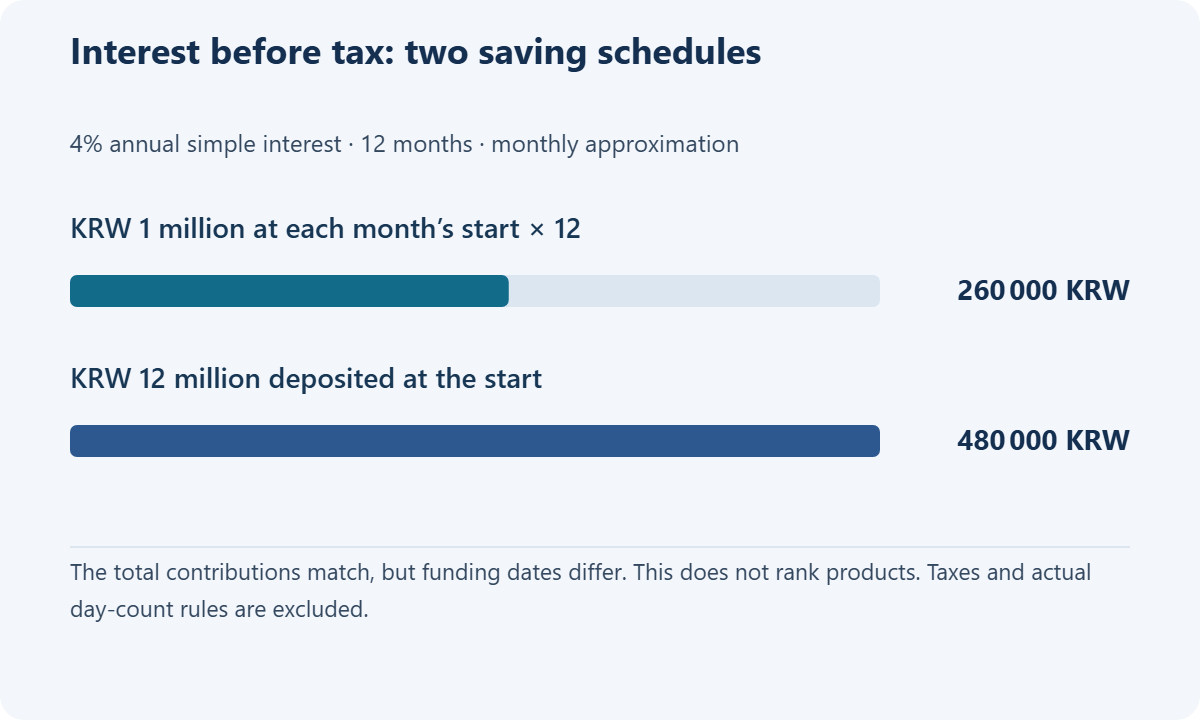
Even at the same annual rate, lump-sum and installment deposits receive money at different times. In a monthly simple-interest example with 12 payments of 1 million South Korean won at the start of each month and an annual rate of 4%, interest is 260,000 South Korean won before tax and 219,960 after tax under the ordinary-taxation assumption.
Depositing 12 million South Korean won up front differs from saving 1 million newly earned each month. Before comparing interest, separate money you have now from money you will receive later. The 4% below is an illustrative assumption, not a currently offered product rate.
Why do lump-sum and installment deposits earn different interest?
A fixed-term lump-sum deposit earns interest on the whole amount from the outset. An installment deposit starts earning on each contribution when it is paid in. In a simplified monthly calculation with 12 start-of-month contributions and maturity at the end of the twelfth month, the first earns for 12 months and the last for 1 month. Giving every contribution a full year's interest is therefore incorrect.
Actual banks may account for days between contribution and maturity, late payments, leap years and contractual terms. Here each month is treated as one twelfth of a year to compare the structures. If whole-won receipt amounts differ, check the product's day-count and tax-truncation methods.
What does 1 million South Korean won monthly for 12 months earn?
With monthly contribution M, annual rate r and n contributions, pre-tax interest for a start-of-month simple-interest installment deposit is M×r÷12×n×(n+1)÷2. Omitting n or mixing annual and monthly units changes the result.
Here, 12+11+…+1=78 months of contributions, so 1,000,000×0.04÷12×78=260,000 South Korean won. Contributed principal is 12,000,000 South Korean won. Assuming 15.4% withholding, comprising 14% income tax and 1.4% local income tax on an ordinary South Korean resident's taxable deposit interest, tax is 40,040, after-tax interest 219,960 and the maturity receipt 12,219,960 South Korean won. Check the National Tax Service withholding rates and the product's tax information.
| Simplified monthly assumptions | Start-of-month installment deposit | Up-front lump-sum deposit |
|---|---|---|
| Contributions | 1 million South Korean won monthly, 12 times | 12 million South Korean won on day one |
| Annual rate and term | 4% · 12 months | 4% · 12 months |
| Pre-tax interest | 260,000 South Korean won | 480,000 South Korean won |
| Tax assuming 15.4% | 40,040 South Korean won | 73,920 South Korean won |
| After-tax interest | 219,960 South Korean won | 406,080 South Korean won |
| Maturity receipt | 12,219,960 South Korean won | 12,406,080 South Korean won |
The lump sum earns more because the same money stays deposited longer. Do not assume you already possess 12 million South Korean won that you have not earned, then conclude that lump-sum deposits are always better.
An equal-starting-funds example: include interest on waiting cash
Now assume you have all 12 million South Korean won at the outset. Depositing it for 1 year at annual 4% produces 480,000 South Korean won before tax. If you transfer 1 million at each month's start into a 4% installment deposit, you must also account for where the untransferred money waits.
| Use of the same initial 12 million South Korean won | Pre-tax interest | After tax assuming 15.4% |
|---|---|---|
| Entire amount in a 4% deposit on day one, 12 months | 480,000 South Korean won | 406,080 South Korean won |
| 1 million South Korean won monthly at the start in a 4% installment deposit + waiting balance at 2% simple interest | 370,000 South Korean won | 313,020 South Korean won |
The second method's installment interest is 1 million South Korean won × 0.04 ÷ 12 × (12+11+…+1) = 260,000 South Korean won. Waiting cash starts at 11 million after the first payment and falls by 1 million each month. Multiplying the sum of monthly balances, 66 million South Korean won, by 0.02 ÷ 12 yields waiting-cash interest of 110,000; together the two earn 370,000 South Korean won.
Actual products vary with day counts, deposit dates, monthly interest payments, rate changes and tax truncation. Here, monthly simple interest and the same 15.4% tax are assumed, and waiting-account interest is not reinvested. For someone saving newly earned salary each month, a day-one deposit of 12 million South Korean won may not be a feasible alternative.
The National Tax Service interest-withholding guidance lists national tax of 14% for ordinary interest. The table's 15.4% is an example including local tax, not a tax-exemption treatment or an individual's final tax outcome. Check the installment and lump-sum portions separately with the deposit-interest calculator, and calculate waiting cash separately.
Verification record: on September 15, 2026, a table of 12 contributions and monthly waiting balances was directly calculated, checking total funds, lump-sum interest, installment interest and waiting interest. Also record any extra spending required for preferential conditions separately from interest in the final comparison.
Conditions and limitations to check just before opening an account
Mark the base and maximum rates, duration of preferential terms, monthly contribution limit, partial-withdrawal availability and early-termination rate in documents from the same date. Check deposit protection product by product. South Korea's Financial Services Commission states that from September 1, 2025, the protection limit increased to 100 million South Korean won per person per financial institution, including principal and prescribed interest. Not all financial products qualify. See its deposit-protection guidance.
Tax exemptions, comprehensive taxation of financial income, nonresidents and special products may differ from this 15.4% example. After-tax figures do not establish an individual's final tax liability. Tying up money needed soon and terminating early may mean the initially compared rate does not apply at all.
Frequently asked questions
Q. Does a 4% installment deposit pay 4% of all contributions?
Not when contributions are spread monthly. Each earns only for its deposited period, so the 12 start-of-month contribution example earns 260,000 South Korean won before tax.
Q. Is the result the same with month-end contributions?
No. Interest-earning periods differ. Distinguish the calculator's start-of-month assumption from actual automatic-transfer and maturity dates.
Q. Does this formula also cover compound interest?
The formula is for simple interest. Compounding requires a different calculation reflecting when interest joins principal and when contributions arrive.
Q. Why not compare only maximum rates?
A preferential rate whose conditions you cannot meet is not your rate. Compare base rates, achievable preferences and the costs of maintaining conditions together.
Q. With protection of 100 million South Korean won, is a deposit of that amount fully protected?
The limit includes prescribed interest. Other protected deposits at the same institution are combined, so check with room for interest included.
Q. Why is the bank's maturity amount slightly different?
Compare daily interest calculations, late contributions, whole-won tax handling and terms. This simplified monthly example does not replace the actual agreement.
Comparison table before opening an account
Collect one row for product | base rate and achievable bonus | actual deposit and maturity dates | gross interest, tax assumption and net interest | early-termination rate and condition costs | deposit-protection eligibility. The 15.4% figure is an example input, not your final tax. Compare deposit, installment savings and waiting cash at the same principal only when the lump sum already exists. If the bank amount differs because of dates, day counts or won-unit truncation, use the product terms and calculation first.
Related
Whether to keep your current silson plan or move to the 5th generation is not de...
Living costs and financeWill switching to a Korean budget mobile plan save money? Compare 12 months of costsCompare staying, switching now and waiting over 12 months of Korean mobile bills...
Living costs and financeEuro travel exchange: compare EUR 500 and ATM feesCompare total won costs for EUR 500, distinguish proportional and fixed fees, an...
Living costs and financeKorean overseas-shopping thresholds: USD 150, USD 200 and tax calculationDistinguish Korea's list-clearance thresholds from taxable customs value and cal...