Comparar intereses de depósitos únicos y ahorro por cuotas: fechas de aportación y resultado neto
Calcule 260.000 wones surcoreanos de interés y 219.960 netos con 12 aportaciones de 1 millón de wones surcoreanos, una al inicio de cada mes, al 4% simple anual. Compare también flujos distintos del depósito único y costes de bonificaciones.
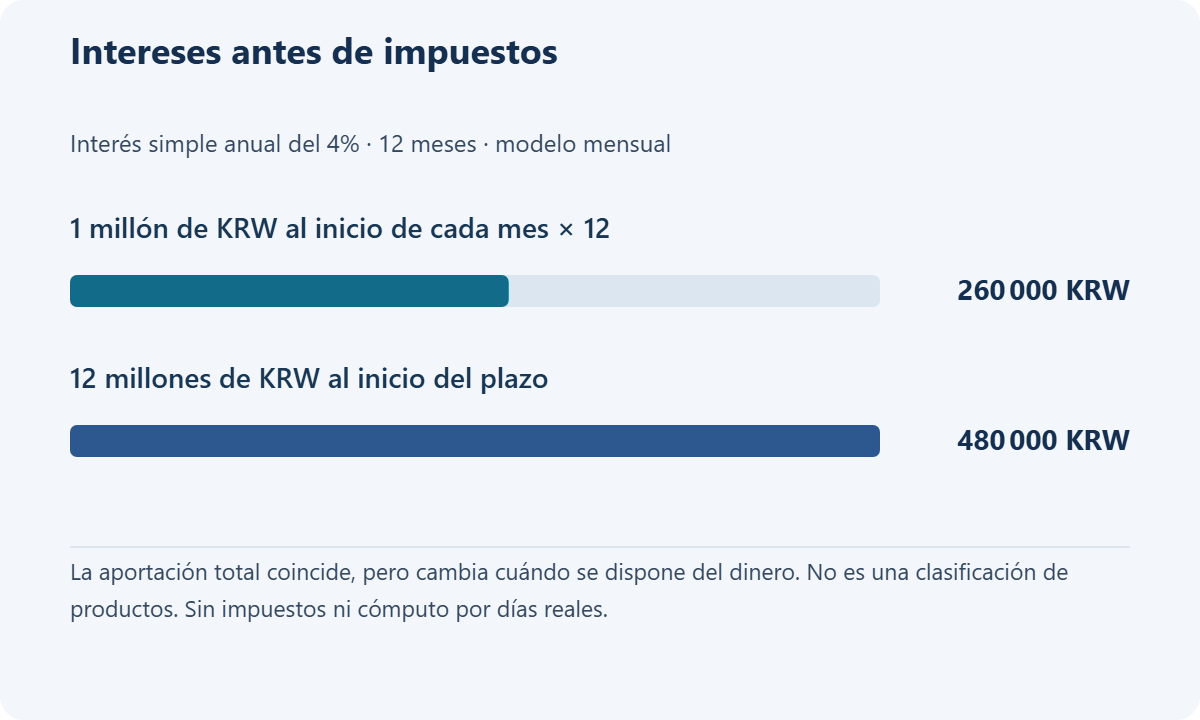
Con el mismo tipo anual, el dinero entra en momentos distintos en un depósito único y uno por cuotas. Con 12 aportaciones de 1 millón de wones surcoreanos al inicio del mes y 4% simple anual, el ejemplo mensual produce 260.000 wones brutos y 219.960 netos bajo tributación ordinaria supuesta.
Depositar 12 millones desde el principio no equivale a ahorrar 1 millón nuevo cada mes. Separe dinero actual y futuro antes de comparar. El 4% es un supuesto ilustrativo, no un tipo comercial vigente.
¿Por qué difieren los intereses?
El depósito a plazo remunera todo el capital desde el principio. Cada cuota empieza a generar interés al entrar. Con 12 cuotas, una al inicio de cada mes, y vencimiento al final del duodécimo mes, la primera genera 12 meses y la última 1 en el modelo mensual. Dar a todas un año completo es incorrecto.
Los bancos pueden considerar días hasta vencimiento, retrasos, años bisiestos y condiciones. Aquí cada mes vale una doceava parte del año para comparar estructuras. Si difieren los wones enteros del recibo, revise días y truncamiento fiscal.
¿Cuánto da 1 millón mensual durante 12 meses?
Con aportación M, tipo anual r y número n, el interés bruto simple de aportaciones al inicio de cada mes es M×r÷12×n×(n+1)÷2. Omitir n o mezclar unidades anuales y mensuales cambia el resultado.
Aquí 12+11+…+1=78 meses de aportaciones: 1.000.000×0,04÷12×78=260.000 wones surcoreanos. El principal es 12.000.000. Para un residente ordinario en Corea del Sur con intereses gravados, se supone retención de 15,4%: renta nacional 14% y local 1,4%. Resultan impuesto de 40.040, interés neto 219.960 y cobro final 12.219.960 wones surcoreanos. Consulte tipos de retención del Servicio Nacional de Impuestos y fiscalidad del producto.
| Supuesto mensual simple | Cuotas al inicio de cada mes | Depósito inicial único |
|---|---|---|
| Aportación | 1 millón de wones surcoreanos al mes, 12 veces | 12 millones de wones surcoreanos el primer día |
| Tipo anual y plazo | 4% · 12 meses | 4% · 12 meses |
| Interés bruto | 260.000 wones surcoreanos | 480.000 wones surcoreanos |
| Impuesto supuesto 15,4% | 40.040 wones surcoreanos | 73.920 wones surcoreanos |
| Interés neto | 219.960 wones surcoreanos | 406.080 wones surcoreanos |
| Cobro al vencimiento | 12.219.960 wones surcoreanos | 12.406.080 wones surcoreanos |
El depósito único gana más porque el mismo dinero permanece más tiempo. No suponga que ya tiene 12 millones aún no ganados para concluir que siempre es mejor.
Igual capital inicial: incluya el interés del dinero en espera
Suponga ahora que dispone de 12 millones desde el principio. A 4% durante 1 año producen 480.000 wones brutos. Si transfiere 1 millón al inicio de cada mes a cuotas al 4%, cuente también dónde permanece lo no transferido.
| Uso de los mismos 12 millones de wones surcoreanos iniciales | Interés bruto | Neto suponiendo 15,4% |
|---|---|---|
| Todo el primer día al 4%, 12 meses | 480.000 wones surcoreanos | 406.080 wones surcoreanos |
| Cuotas de 1 millón al inicio de cada mes al 4% + saldo en espera al 2% simple | 370.000 wones surcoreanos | 313.020 wones surcoreanos |
El interés de cuotas del segundo método es 1 millón de wones surcoreanos × 0,04 ÷ 12 × (12+11+…+1) = 260.000 wones surcoreanos. Tras la primera cuota esperan 11 millones y disminuyen 1 millón mensual. La suma de saldos mensuales, 66 millones, por 0,02 ÷ 12 da 110.000 de interés en espera; juntos suman 370.000 wones surcoreanos.
Los productos reales varían por días, fechas, pago mensual de intereses, cambios de tipo y truncamiento fiscal. Aquí se asumen interés simple mensual y el mismo 15,4%, sin reinvertir intereses de la cuenta de espera. Para quien ahorra salario nuevo mensual, 12 millones el primer día quizá no sean una alternativa disponible.
La guía fiscal de retención sobre intereses indica 14% nacional para intereses ordinarios. El 15,4% incluye impuesto local como ejemplo; no representa exención ni tributación final personal. Compruebe depósitos y cuotas por separado en la calculadora de intereses; calcule el saldo en espera aparte.
Registro de comprobación: el 15 de septiembre de 2026 se tabularon directamente 12 cuotas y saldos mensuales en espera, cotejando fondos totales e intereses del depósito, cuotas y espera. Anote aparte cualquier gasto adicional exigido por bonificaciones para la comparación final.
Condiciones y límites antes de contratar
Marque tipo base y máximo, duración de bonificación, límite mensual, retirada parcial y tipo de cancelación anticipada en documentos del mismo día. Verifique protección por producto. La Comisión de Servicios Financieros surcoreana explica que desde el 1 de septiembre de 2025 el límite subió a 100 millones de wones surcoreanos por persona e institución, incluido capital e interés previsto. No cubre todos los productos. Consulte su guía de protección de depósitos.
Exenciones, tributación conjunta de rendimientos financieros, no residentes y productos especiales pueden diferir del 15,4%. El neto no fija la carga fiscal final individual. Inmovilizar dinero necesario pronto y cancelar puede impedir incluso aplicar el tipo comparado inicialmente.
Preguntas frecuentes
Q. ¿Un ahorro al 4% paga 4% de todas las cuotas?
No si se aportan mensualmente. Cada una cobra por su permanencia; las 12 aportaciones al inicio de cada mes del ejemplo dan 260.000 wones surcoreanos brutos.
Q. ¿Da igual aportar al final del mes?
No. Cambia el tiempo remunerado. Distinga supuesto inicial de la calculadora y fechas reales de transferencia y vencimiento.
Q. ¿Sirve la fórmula para interés compuesto?
Es interés simple. El compuesto requiere otro cálculo con frecuencia de capitalización y fechas de aportación.
Q. ¿Por qué no comparar solo máximos?
Una bonificación inalcanzable no es su tipo. Compare base, bonificación posible y coste de mantenerla.
Q. ¿Depositar 100 millones está totalmente protegido con un límite de 100 millones?
El límite incluye intereses previstos y suma otras cuentas protegidas de la misma institución. Compruebe dejando margen para intereses.
Q. ¿Por qué difiere un poco el vencimiento bancario?
Revise intereses diarios, retrasos, tratamiento del impuesto en wones y cláusulas. El ejemplo mensual no sustituye el contrato.
Tabla comparativa antes de contratar
Recoge una fila por producto: producto | interés base y bonificación alcanzable | fechas reales de ingreso y vencimiento | interés bruto, supuesto fiscal e interés neto | interés por cancelación y costes de condiciones | protección de depósitos. El 15,4 % es un dato de ejemplo, no tu impuesto final. Compara depósito, ahorro periódico y efectivo en espera con el mismo principal solo si ya dispones del capital. Si las fechas, días o truncamientos explican una diferencia, prevalecen las condiciones y el cálculo del producto.
Relacionado
Mantener su silson actual o pasar a la 5.ª generación no se decide solo por la p...
Coste de vida y finanzasCambiar de tarifa móvil: calcule el coste real de 12 mesesCompare mantener la tarifa, cambiar hoy o esperar incluyendo penalizaciones, cuo...
Coste de vida y finanzasEuros para viajar: compare coste total, cajeros y conversión DCCCompare el total en wones por los mismos 500 euros. Los ejemplos separan margen ...
Coste de vida y finanzasCompras del extranjero a Corea: límites de USD 150 y USD 200 e impuestosDistinga el umbral del despacho por listado del valor en aduana. Calcule arancel...