Youth housing finance in Korea: rental deposits versus buying a home
Separate rental-deposit loans, home-purchase finance and subscription accounts, then calculate your funding gap and check current eligibility with the bank.
Financing a rental deposit and financing a home purchase are different tasks. Decide whether you are renting, buying or preparing for a housing subscription before comparing products.
Rental and purchase loans serve different purposes
The Youth-only Beotimmok rental loan provides funds for a rental deposit. Housing-finance arrangements linked to the Youth Housing Dream subscription account concern subscription and home acquisition. A low advertised purchase-loan rate is not an available alternative for somebody who needs a rental deposit.
Use the Housing and Urban Fund youth rental-loan guide for rental conditions and the official MyHome Youth Housing Dream account guide for the purpose of the linked account and financing framework. A figure in an old launch announcement is not necessarily today's application rate or limit. Confirm current conditions with the Fund's current product page and handling bank.
For a purchase, open the official Youth Housing Dream Didimdol loan product page. This product is for someone who won a housing subscription using the Youth Housing Dream account; at application it also checks at least one year of account membership and KRW 10 million in qualifying deposits, among other conditions. Merely opening the account does not qualify you for the purchase loan.
Five checks for the youth Jeonse loan
These general criteria were checked in the Housing and Urban Fund's youth Beotimmok guide on 2026-09-28. They concern a rental-deposit loan, not a home-purchase loan.
| Check | General rule and evidence |
|---|---|
| Age and household | Household head or prospective head, aged 19–34 at application; check date of birth and resident-register household details |
| Ownership | All household members, including the head, must not own a home; checking only the applicant is insufficient |
| Income | Basic combined annual income ceiling for applicant and spouse: KRW 50 million; prepare income and employment/business evidence |
| Assets | Combined net assets of applicant and spouse: no more than KRW 345 million under the 2026 criterion; official assessment includes more than cash in the bank |
| Contract and home | Signed residential lease and at least 5% of the deposit paid; generally exclusive area up to 85 m² and deposit up to KRW 300 million; sole household heads under 25 have a 60 m² area limit |
This is not an approval checklist covering every exception. Official rules include military-service age extensions for specified SME/mid-sized-company workers or supported founders, income exceptions for some households and certain shared-house exceptions. Check an applicable exception before ruling yourself out. Meeting these five checks still leaves overlapping-loan restrictions, credit, asset and collateral/guarantee assessment. The asset threshold changes by year.
Before signing, ask the bank to check the proposed home and your circumstances. Distinguish that preliminary check from the signed-contract and 5%-payment requirements at application. Prepare the lease, payment proof, household register and income/employment records, and record the balance-payment and move-in registration dates. The general application deadline is within three months of the earlier of those two dates; for renewal it is within three months of renewal. The guarantee has its own deadline. These limits do not promise disbursement before your balance is due: obtain the bank's processing schedule and additional-document list first.
Gather the four fields first
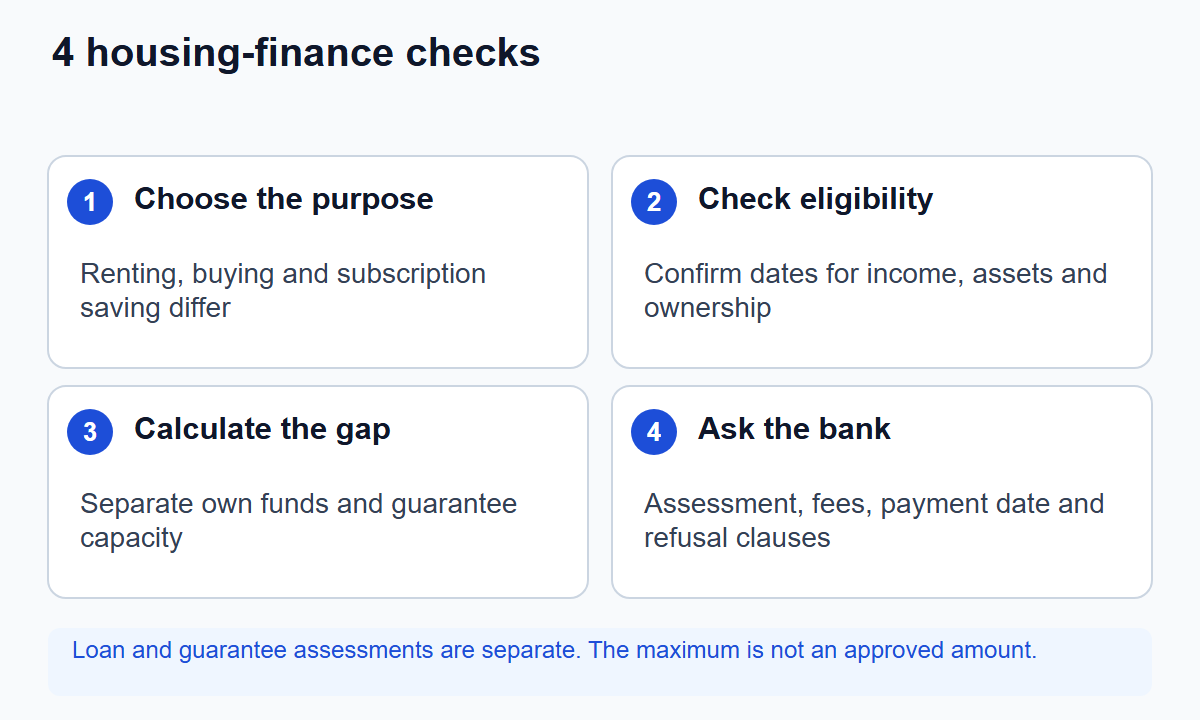
Write the purpose and application date, then collect household status, income, assets, existing loans and contract or deposit records. Match the official product with bank and guarantee answers on one sheet.
Fix the purpose, shortfall and result
Read the Easy Law guide and official Youth 버팀목 guide. Record purpose/date, amount needed, product/eligibility/property/guarantee/limit, bank answer, approved amount and shortfall. A 180,000,000 KRW deposit minus 60,000,000 KRW cash needs 120,000,000 KRW; approval of 100,000,000 KRW leaves a 20,000,000 KRW gap, so hold the decision. Choose official self-check complete, bank review needed, conditions not met, or hold until solved. 100,000,000 × 0.03 ÷ 12 = 250,000 is a calculation example, not a current rate. Savings terms and loan approval are separate.
Frequently asked questions
Q. Can I choose whichever product has the lower interest rate?
Only after purpose and eligibility match. Products for different uses cannot be compared by rate alone.
Q. Will I receive the advertised maximum?
Not necessarily. Contract value, own funds, guarantee/collateral limits and bank assessment can reduce the amount.
Q. Does owning a subscription account guarantee purchase-loan approval?
No. Account and payment conditions are separate from loan eligibility and collateral assessment.
Q. Is an online calculation a confirmed loan amount?
No. It is preparation. The bank and guarantor decide after checking the application documents.
Q. Can I sign the property contract before checking finance?
That can put the contract payment at risk. Review prior financing checks and the effect of refusal clauses with the agent and a legal professional as appropriate.
Q. Is the example's 3.0% today's available rate?
No. It is an arithmetic assumption. Use the official rate effective when applying.
Reviewed September 8, 2026. Lending, guarantee and tax outcomes depend on current rules and personal circumstances. This guide promises neither approval nor savings.
Related
Calculate rental-value thresholds, a KRW 700 million sale fee and negotiated cha...
Housing and contractsKorean housing holding taxes in 2026: separate property tax and comprehensive taxSeparate per-home property tax from per-person comprehensive tax using official ...
Housing and contractsCompare Korean apartment transactions: area, dates and cancellationsMatch official contract records, calculate price per square metre and median, an...
Housing and contractsCash, installments or leasing: compare car costs over 60 monthsCompare the same car over 60 months using complete cash flows, loan interest, re...